Russian oil supplies through the Druzhba pipeline halted after strikes
Russian oil supplies through the Druzhba pipeline to European countries were completely halted after strikes by the Armed Forces of Ukraine (AFU) during the night of August 17–18.
Reports of damage
Commander of the AFU Drone Systems Forces Robert “Madyar” Brovdi reported that drones struck the Nikolskoe oil pumping station in Russia’s Tambov region, located 400 km from the front line. According to him, as a result of the strikes, the operation of the Druzhba pipeline was completely halted.
The General Staff also confirmed the damage to the pumping station. “The Nikolskoe oil pumping station is part of Russia’s economic infrastructure and is involved in supplying the occupying forces of the Russian aggressor,” the General Staff noted in its update.
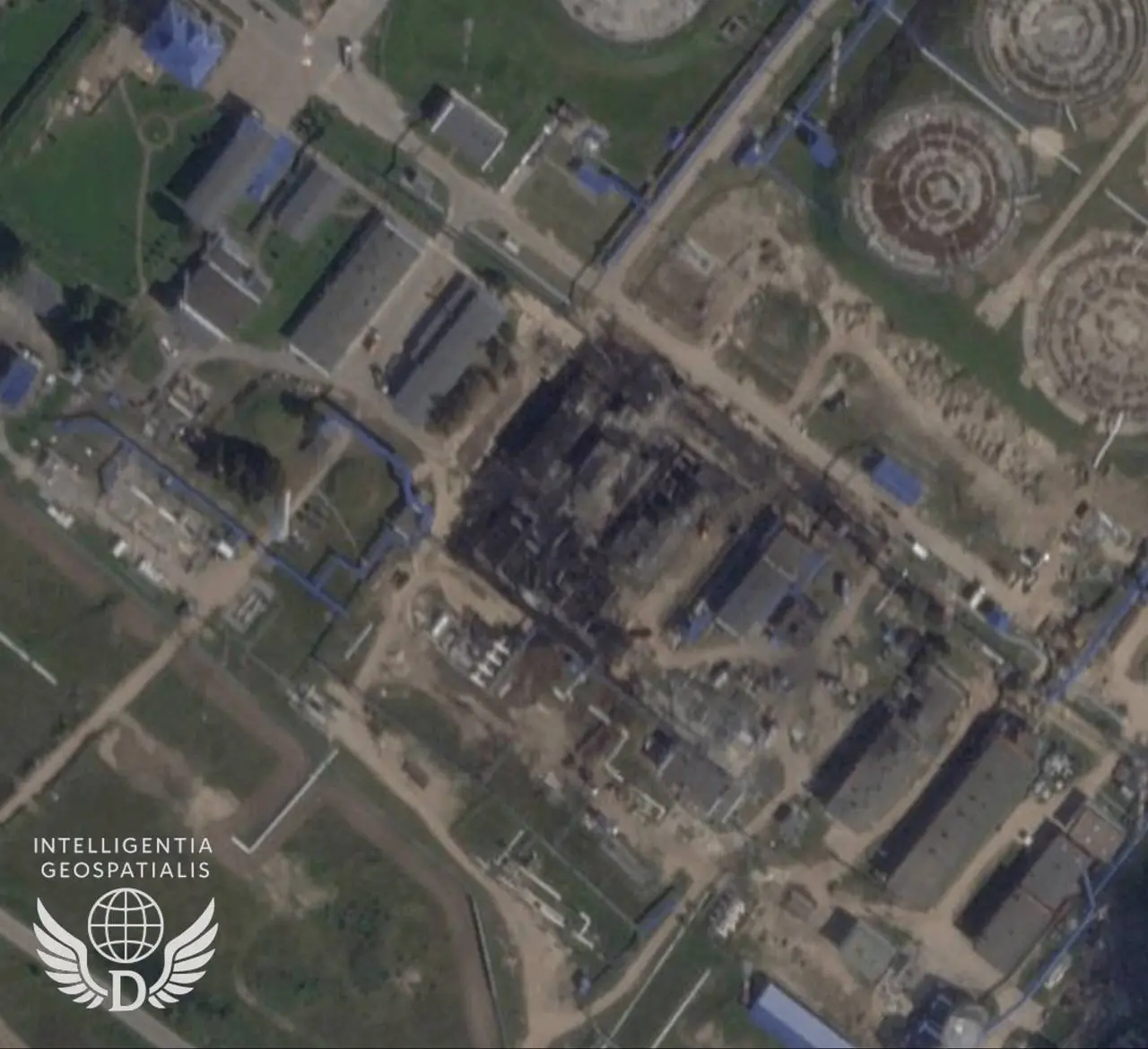 Satellite image of damage to the Nikolskoe station after AFU strikes
In addition to pumping oil, the station also pumps, stores, and distributes aviation and diesel fuel, gasoline, and fuel oil. The facility processes up to 300 thousand tons of products per day.
Hungarian Foreign Minister Péter Szijjártó confirmed the suspension of oil supplies to his country, once again accusing Ukraine of undermining Hungary’s energy security. Slovak company Transpetrol also reported the suspension of oil supplies through the Druzhba pipeline.
Unecha station
It should be recalled that during the night of August 13, another pumping station of the Druzhba pipeline – Unecha in Russia’s Bryansk region – was hit. However, the previous attack did not result in a prolonged shutdown of the pipeline.
Unecha is one of the key hubs of the Druzhba pipeline, from which the pipeline splits into two branches: the northern branch (Belarus, Poland, Germany) and the southern branch (Ukraine, Hungary, Slovakia, Czech Republic).

Transit volumes
Before the strikes, Ukraine continued transporting Russian oil through the Druzhba pipeline to Hungary and Slovakia. Oil supplies to the Czech Republic ceased on March 4 after the country stopped purchasing from Russia. In compliance with EU sanctions against Russia for the invasion of Ukraine, the Czech Republic found an alternative to Russian oil by upgrading the Transalpine Pipeline (TAL) and connecting to it via the IKL system. The country can now import up to 8 million tons per year of oil delivered from European ports and no longer plans to return to Russian oil purchases.

According to ExPro, since the beginning of the year, Ukraine transported 7.05 million tons of Russian oil through the southern branch of the Druzhba pipeline until the suspension of supplies on August 18. Transit volumes increased compared to the same period last year by almost 3% – from 6.86 million tons to 7.05 million tons – despite the halt in oil supplies to the Czech Republic.
Thus, Russian oil supplies to Slovakia in 2025 increased almost 1.5 times compared to the same period in 2024, to 3.37 million tons. Oil supplies to Hungary rose by 5%, to 3.17 million tons. Meanwhile, Russian oil supplies to the Czech Republic fell 1.7 times, to 0.52 million tons in the first months of the year.
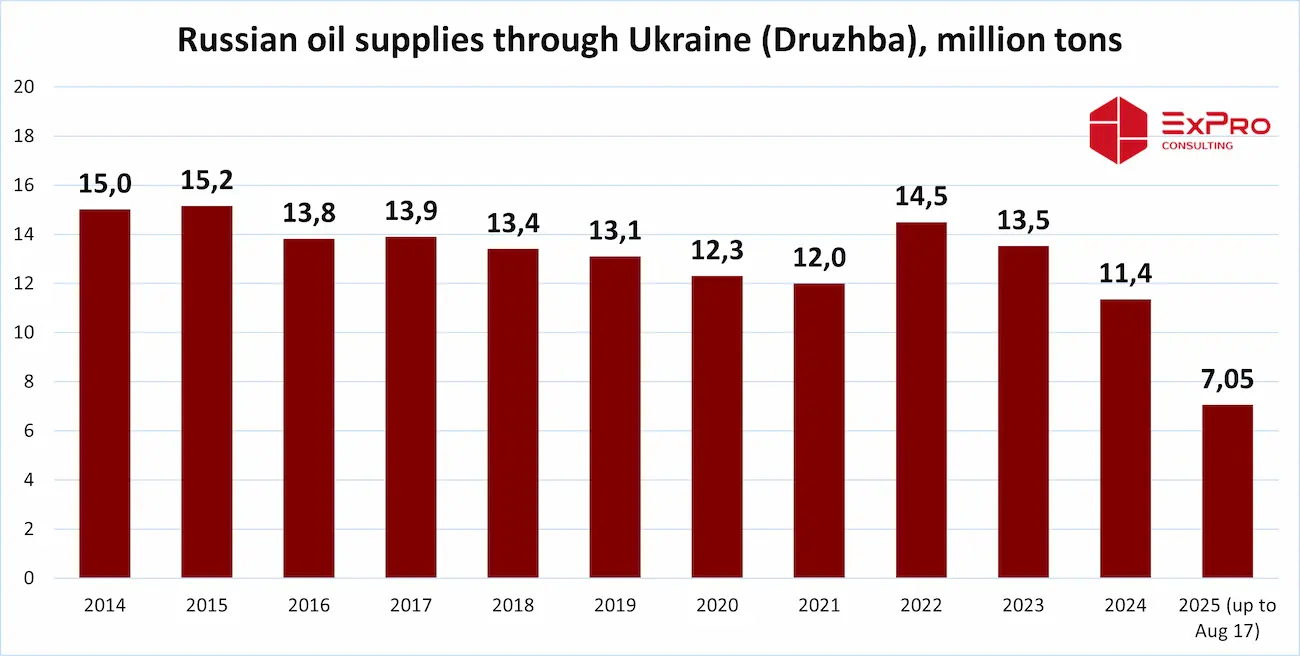
As reported by ExPro, Russian oil transit through Ukraine in 2024 amounted to 11.36 million tons, the lowest level in at least the past 10 years, and likely since 1991.
Where to find Ukrainian crude oil market analytics?
Detailed analytics of the oil market, including data on transit, production, import, export, and oil trading in Ukraine, is published in the specialized publication ExPro Gas&Oil Monthly.
You can request a sample issue or subscribe to ExPro publications on the oil or natural gas market via e-mail: [email protected]
10:10 / 19 August 2025
Articles
11:16 / 2 January, 2026
Gas imports to Ukraine hit a five-year high at 6.5 bcm in 2025
10:29 / 16 July, 2025
Ukraine’s Recovery: Energy as a Priority
11:50 / 2 July, 2025
Ukraine boosts natural gas imports twelvefold
13:22 / 27 May, 2025
Gas prices in Ukraine surge: Highest level in over two years
13:17 / 26 May, 2025
Ukraine injects over 1 bcm of gas into storages
12:09 / 19 May, 2025
Special Issue: When Will Europe Switch to SDAC 15-minute intervals?
10:05 / 3 February, 2025
Special materials: Energy Mix of Neighbouring Countries in 2024: Coal, Nuclear, and the "Green" Path