Romania to reduce gas tariffs and offer annual capacity to Ukraine
Romanian gas transmission system operator Transgaz will reduce capacity booking tariffs and start offering annual export capacity toward Ukraine at the Isaccea-1/Orlovka interconnection point starting from the 2026/2027 gas year (October 1, 2026).
Transgaz reduced annual capacity booking tariffs by an average of 10% and eliminated the difference between intra-season tariffs. This means that during peak consumption months, particularly in January, tariffs could drop by approximately 50%.
Transgaz also updated gas quality requirements, setting the minimum methane content at 70%. This is important for transporting gas from south to north via the Trans-Balkan route, particularly toward Ukraine and Moldova.
Furthermore, Transgaz is to offer annual firm bundled capacity to Ukraine at the Isaccea-1/Orlovka point for the next five gas years, starting October 1, 2026. This involves 62 GWh/day, which technically corresponds to around 2.1–2.2 bcm of gas per year.
The capacity must be offered on a competitive basis and requires approval from ANRE. Such a step could allow companies in Ukraine and Moldova to import gas from the Romanian market, rather than only via transit from the southern direction.
Vertical Corridor
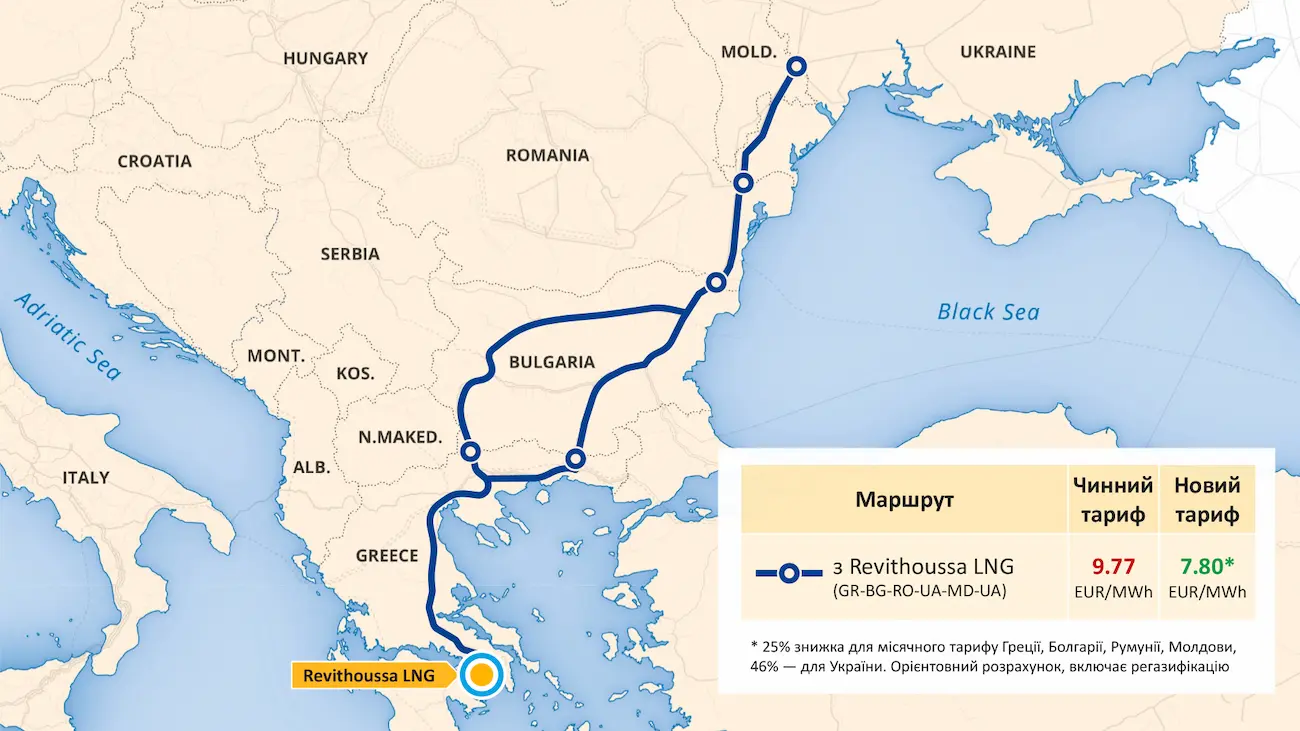
The Vertical Gas Corridor is a regional gas supply route from the south to the north of Europe through the infrastructure of Greece, Bulgaria, Romania, Moldova, and Ukraine, as well as toward Hungary and Slovakia. It aims to provide access to LNG from Greek terminals, specifically via Revithoussa and Alexandroupolis, as well as to gas from other southern sources.
Within the Vertical Corridor, three joint route products are available for gas imports to Ukraine.
Route 1 connects the Greek LNG terminal Revithoussa with Ukraine via the Kulata/Sidirokastron, Negru Voda/Kardam, Isaccea/Orlovka, Kaushany, and Grebenyky interconnection points. The route became operational in July 2025. According to ExPro, over 70 mcm was imported through it in 2025. In March 2026, the entire offered monthly capacity of Route 1 was booked, totaling around 2.41 mcm/day, or nearly 75 mcm for the month.
Route 2 is designed for importing LNG from the Greek Alexandroupolis terminal to Ukraine via Amfitriti, Komotini DESFA/IGB, Stara Zagora, Negru Voda 1/Kardam, Isaccea 1/Orlovka, Kaushany, and Grebenyky.
Route 3 is designed for importing Azerbaijani gas via TAP and IGB, and further along the same route through Bulgaria, Romania, and Moldova to Ukraine. Route 2 and Route 3 were launched in December 2025, but no gas imports have been carried out via these routes yet.
18:16 / 9 June 2026
Articles
11:16 / 2 January, 2026
Gas imports to Ukraine hit a five-year high at 6.5 bcm in 2025
10:29 / 16 July, 2025
Ukraine’s Recovery: Energy as a Priority
11:50 / 2 July, 2025
Ukraine boosts natural gas imports twelvefold
13:22 / 27 May, 2025
Gas prices in Ukraine surge: Highest level in over two years
13:17 / 26 May, 2025
Ukraine injects over 1 bcm of gas into storages
12:09 / 19 May, 2025
Special Issue: When Will Europe Switch to SDAC 15-minute intervals?
10:05 / 3 February, 2025
Special materials: Energy Mix of Neighbouring Countries in 2024: Coal, Nuclear, and the "Green" Path