


The Energy Community Secretariat has issued another assessment of the Ukrainian electricity market.
The main topic was the establishment of new price caps.
ExPro reminds that from July 1, the following cap prices apply for short-term segments:
On the Day-Ahead Market
- maximum cap prices for minimum load hours (from 00:00 to 07:00 AM and from 11:00 to 12:00PM) – UAH 3,000/MWh, for maximum load hours (from 07:00AM to 07:00 PM) – UAH5,600/MWh, for evening peak hours (from 07:00 to 11:00) - UAH7,200/MWh;
- the lower cap price is UAH10/MWh;
On the Intra-Day Market
- maximum cap prices for minimum load hours (from 00:00 to 07:00 AM and from 11:00 to 12:00PM) – UAH 3,000/MWh, for maximum load hours (from 07:00AM to 07:00 PM) – UAH5,600/MWh, for evening peak hours (from 07:00 to 11:00) - UAH7,200/MWh;
- the lower cap price is UAH10/MWh;
In the Balancing Market
- the higher cap price - 125% of the DAM price determined by the market operator for each billing period of the corresponding delivery day;
- the lower cap price is UAH0,01/MWh.
Particularly, the Secretariat summarized the chronology of changes in price caps on the Ukrainian market from 2020.
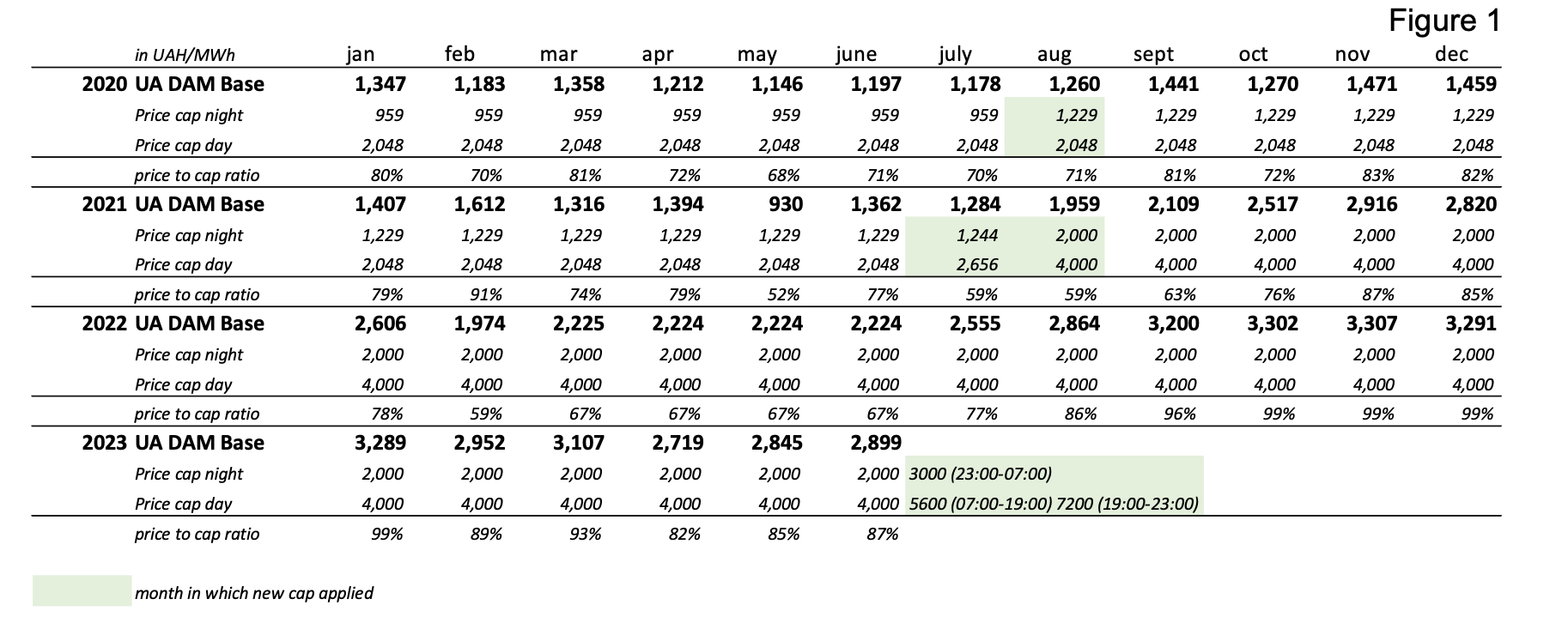 Comparing prices in the Ukrainian and European markets (markets of neighbouring countries - Poland, Romania, Slovakia, and Hungary), energy community analysts pointed out that prices for the base load on the Day-Ahead Market in Ukraine are significantly lower than in neighbouring EU member states. "Ukrainian prices were higher than in the EU for only a few days/hours (for example, in June and July 2023) due to the high level of renewable energy production and negative prices in the EU, which was hindered in Ukraine by the minimum prices applied until July 1, 2023, and the absence of a negative price," the Ukraine Energy Market Observatory said.
The Secretariat notes that the continuation of the practice of regulating price caps at a level significantly lower than in neighbouring markets will have a negative impact on attracting the necessary investments and ensuring sufficient resources in the Ukrainian market. Additionally, the current level of price caps poses a risk to the security of supplies in the coming autumn-winter period. Considerable attention is paid to attracting commercial imports to cover the deficit in the Ukrainian energy system, especially in the autumn-winter period.
According to the Europeans' analysis, market incentives for commercial imports in the autumn-winter period remain questionable. According to their forecast, prices on the Ukrainian Day-Ahead Market are likely to remain lower than forward prices in neighbouring EU member states, thus minimizing commercial incentives for electricity imports to Ukraine, but on the contrary, making exports more attractive. At the same time, a power shortage can occur at any time of the day, which also requires a mechanism for attracting imports to cover it.
What is the impact on the market under current price caps?
In terms of supply:
The growth of upper price caps allows electricity producers, both state and private, to increase their liquidity and attract resources to prepare for the autumn-winter period. At the same time, reducing the lower cap price reduces the income of the Guaranteed Buyer. As the Energy Community indicated, this can be offset by trading at other hours, at higher prices.
The Energy Community adds that the relationship between price caps on the DAM and the balancing market creates the risk of not fully covering balancing costs.
"Price regulation in the balancing market and the auxiliary services market may limit the ability of the Transmission System Operator to activate the required volume of balancing services and form the budget necessary for their payment," Ukraine Energy Market Observatory said.
In terms of demand:
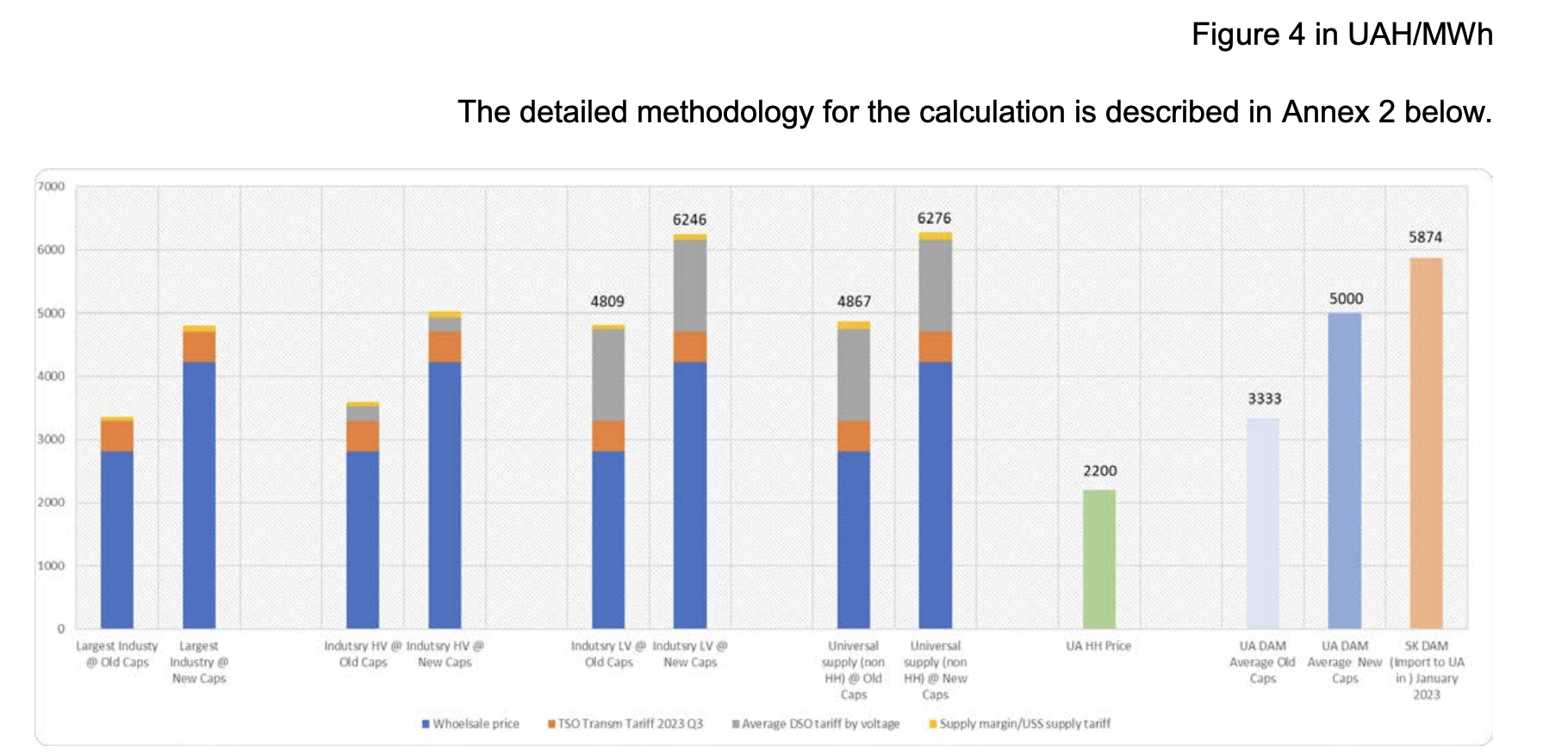
The Secretariat estimates that there will be no sharp impact on the price due to the establishment of new price caps. In the most extreme scenario, the dynamics of the market price under the new price caps can lead to a situation where prices for consumers (not for the population) will increase in the range of 30-40% by the end of 2023.
Potential dynamics of electricity prices for end users, UAH/MWh
Findings
The Energy Community Secretariat provided recommendations for Ukraine:
1. Revision of price caps is a prerequisite for full integration of the electricity markets of Ukraine and the European Union.
2. NEURC should develop a roadmap for further liberalisation of price caps. The ultimate goal should be to apply agreed minimum and maximum price caps based on an appropriate adjustment mechanism in the EU.
3. The decision on price caps should include market incentives for import/export; an automatic price adjustment mechanism.
4. NEURC should maintain its independence and not apply to the Ministry of Energy, public or private bodies, or individuals for "proposals for price restrictions" as this violates the acquis requirements regarding the independence of the regulatory body. Additionally, there is a need to increase transparency, in particular by justifying the proposed figures, including the contribution of stakeholders with whom consultations are held.
5. Price regulation should not be used as a tool aimed at preventing market manipulation. There is a REMIT mechanism for this. And even before the full implementation of this mechanism, the regulator should carefully monitor the behaviour of licensees and investigate possible abuses in the market.