


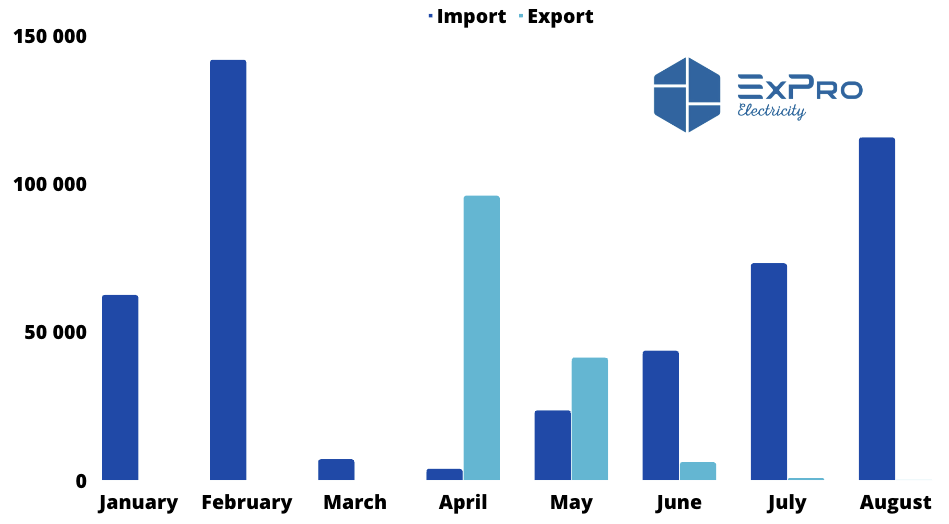
New price caps have been in effect in the electricity market in Ukraine for the second month. In August, electricity imports increased by 57.6%, to 115.6 thousand MWh. At the same time, exports fell another 4 times. Only 204 MWh was delivered during one day for the entire month.
During the last month of summer, total import volumes, despite a significant shortage in the energy system, did not reach a record value for the year. By the way, in February bigger volumes were imported, which exceeded 140 thousand MWh.
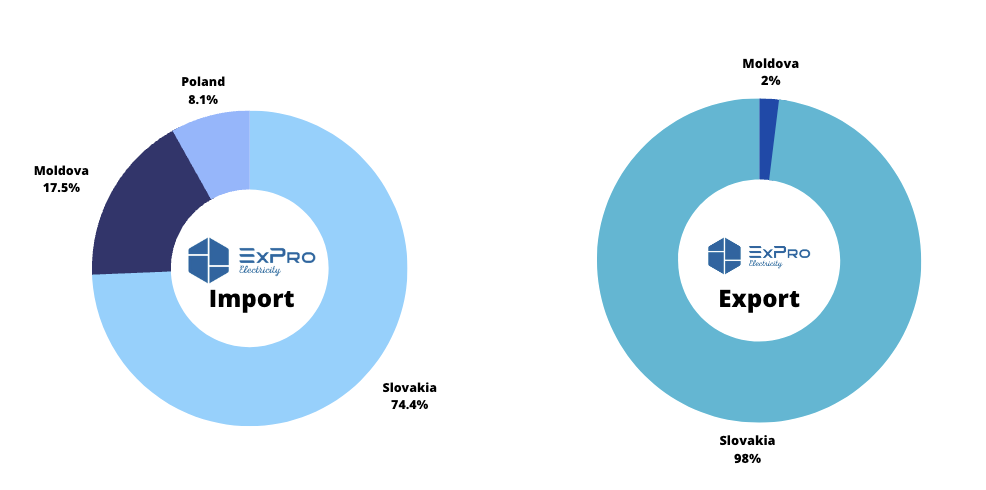
Electricity imports from Poland increased significantly, from 800 MWh in July to 9,410 MWh in August. Imports from Slovakia and Moldova increased by 46% and 47%, respectively.
At the same time, according to ExPro, in September, electricity imports from Poland will be reduced, due to the limitation of the proposed capacity to 0 MW for most days.
By the way, a new player has entered the Polish direction. It is Euromin Energy, part of the well-known international company - Vitol. Previously, DTEK was usually an importer from Poland.
Most imports in August were on August 3 and exceeded 6.6 thousand MWh. But again, this is far from a record. At the same time, at the end of the month, imports began to decline sharply, due to rising prices in the neighbouring European markets.
It should be noted that since July this year, new price caps have been applied on the market: UAH3,000, 5,600, and 7,200/MWh, depending on the time of the day. The main argument from the Regulator was to provide an opportunity to attract imports to cover deficits.
"An indicator of the effectiveness of the decision on new price caps in the electricity market will be an increase in imports exactly at the hours when it is most needed by the energy system," they said in Ukrenergo.
But August was a record for attracting emergency assistance. Obviously, the (non-)effectiveness was proven. The largest volumes of commercial imports come from Slovakia. In August, prices in the Slovak Day-Ahead Market for evening peak hours increased, especially at the end of the month. Occasionally, prices reached €300/MWh - exactly for those hours that are deficit for Ukraine.
Let us compare the average hourly import volumes from Slovakia for July and August.
Average hourly imports from Slovakia, for July and August, MW
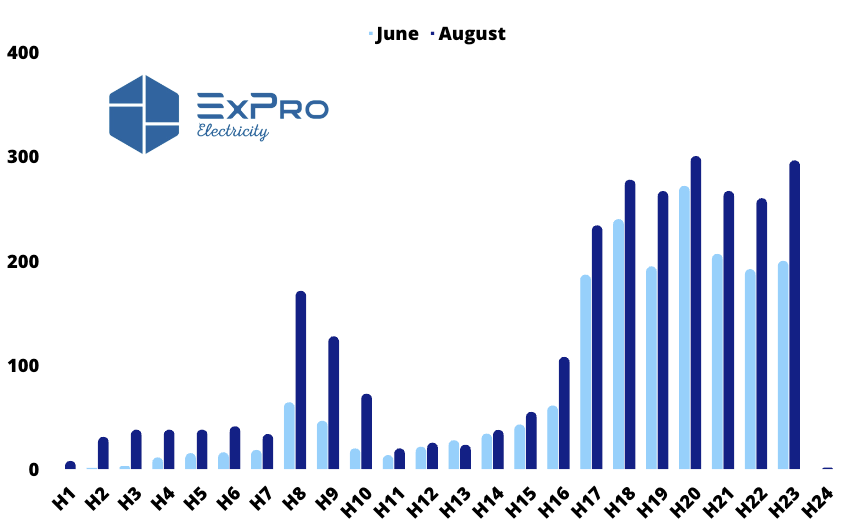
Ukraine imports most electricity during the morning and evening peak hours to cover the internal deficit. Also, in August, imports for night hours increased slightly.
However, after the introduction of new price caps in the market, the issue of full access to imports remained.
"Ukrenergo believes that prices in Ukraine should allow free electricity imports. It is important for balancing the power grid. The current price caps do not promote imports during the hours when it is needed, and vice versa, they encourage imports when there is no need for it," the press service of Ukrenergo commented for ExPro regarding the effect of price caps.
ExPro calculated the difference in hourly prices between the Ukrainian and Slovak markets.
In August, 51% of hours in the Ukrainian market were more expensive than in Slovakia (the hourly price for DAM in Ukraine, according to the Market Operator, exceeded the prices for DAM in Slovakia, according to Okte), 49%. That is, 51% of the hours in August were favourable days for the electricity import. If we divide August into 2 parts (1-15.08 and 16.08), in the first half of the month 66% of hours were profitable for imports, in the second half – only 34%.
Emergency assistance in August
August was a record for attracting emergency assistance from the neighbouring operators in Romania, Slovakia, and Poland.
"Now emergency assistance is used in conditions of a shortage of power grid capacity (repair campaign at power plants + increased consumption due to heat) and due to a limited amount of imports," Ukrenergo commented for ExPro.
In total, 18,750 MWh was attracted in August. A record amount of emergency assistance was attracted on August 22 – 2,900 MWh.
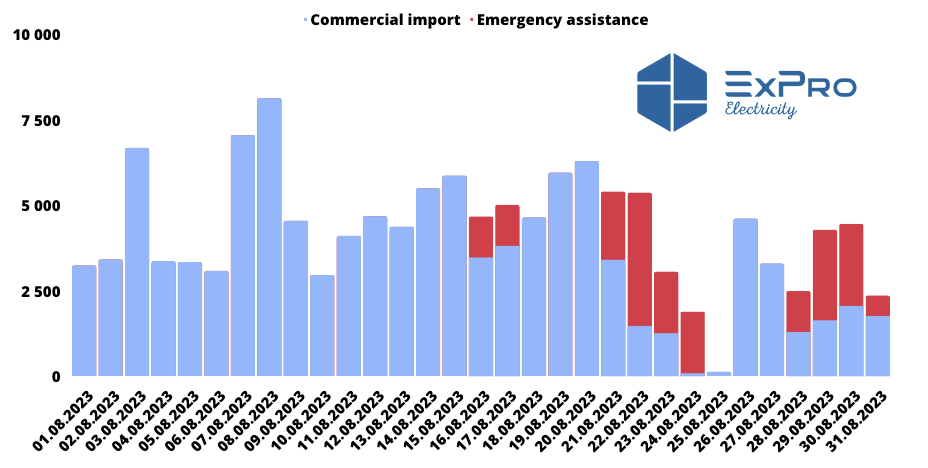
Occasionally, the volume of emergency assistance exceeded the volume of commercial imports.
As Ukrenergo explained, this is the last tool before the possible application of consumer restrictions, since when emergency assistance is involved, all internal reserves of the energy system are exhausted.
The cost of emergency assistance is several times higher than the spot market price, and the burden is borne by the System Operator Ukrenergo.
At the same time, the Regulator expressed a slightly different position on the problem of "emergency assistance and commercial import".
"The task of Ukrenergo is to attract the maximum amount of domestic generation, including thermal generation, to cover demand," Kostyantyn Uschapovsky, Chair of the National Energy Regulation Commission, said.
The Regulator indicated that Ukrenergo should prepare appropriate changes to the temporary procedure for purchasing auxiliary services to ensure frequency and active power regulation in the IPS of Ukraine as soon as possible.
"This necessary step will not only increase the amount of available capacity in the power grid, but also significantly reduce the need for emergency assistance. It will also ensure the safety of electricity supply and regulate network restrictions, allow efficient and rational use of fuel and energy resources in the production of electric energy, in particular, to save natural gas," Uschapovsky said.
NEURC's report did not comment on the adjustment of price caps to attract more imports.